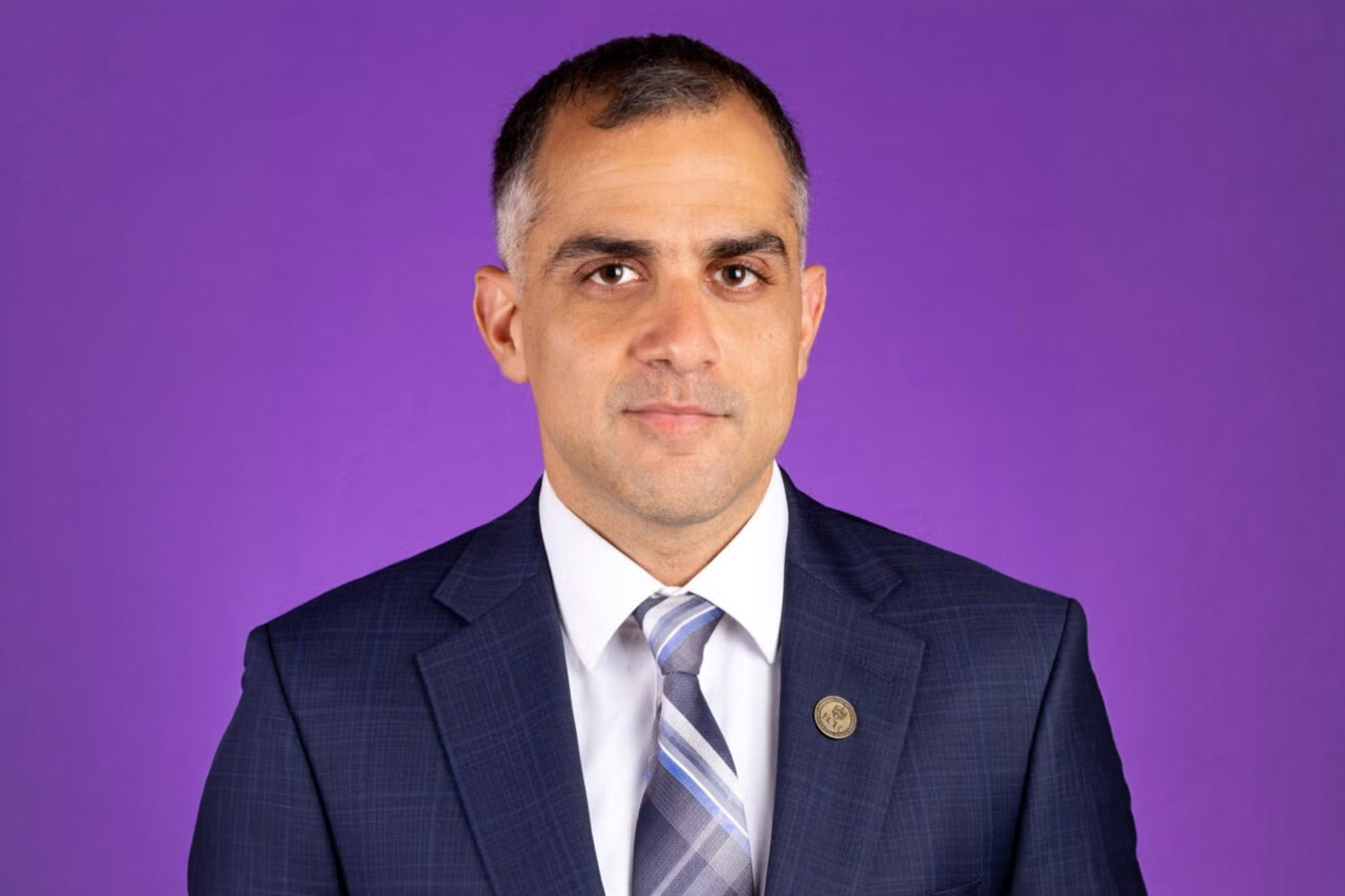
Dr. Robert Nalbandov: Preparing Security Studies Students for a Changing World
Written by: East Carolina University® • May 26, 2026

The global landscape is evolving quickly, driven by a range of forces. Competition between powerful nations, regional conflicts, migration, energy disruptions, and the emergence of artificial intelligence (AI) are all influencing how nations interact and how institutions respond. In that environment, fields such as international relations and security have become increasingly relevant for those who want to understand the world—and help shape it.
At East Carolina University® (ECU), students learn from faculty whose expertise extends well beyond the classroom. Dr. Robert Nalbandov , a teaching assistant professor and program coordinator for ECU’s online Bachelor of Science (BS) in Security Studies , has worked in academia, foreign policy, the non-profit sector, strategic consulting, global development, and international law in multiple countries. His journey in the field reflects both intellectual curiosity and firsthand experience with geopolitical change.
A Career Shaped by History and Global Experience
Nalbandov’s interest in international relations began with a lifelong fascination with the nexus between politics and history and the broader social sciences. A self-described history buff, he was especially interested in how conflict and cooperation shape human civilizations, including those of the Greeks, Persians, Roman, and Egyptians.
His personal background also had an impact on his path. Born in the nation of Georgia during the Soviet era, Nalbandov grew up during a period of dramatic political change. By the time he entered higher education, the Soviet Union had collapsed, Georgia was newly independent, and questions of foreign policy and international engagement had taken on new urgency.
After earning undergraduate degree in English and an MPA, he entered Georgia’s foreign service, where he regularly engaged with dignitaries from around the globe.
“I was the one rubbing shoulders with the secretary of state, with the American ambassador, with the secretary general of NATO,” he says, adding, “Not that I was that important, but I was running around with these guys.”
The experience also brought into focus a larger ambition: “I was really interested in not being left out of the negotiation rooms, but present in foreign policy-making.”
That goal led him to graduate study abroad, taking advantage of the Edmund S. Muskie/FREEDOM Support Act—which used U.S. congressional funding to provide scholarships to foreign students—to enroll at The Fletcher School of Law and Diplomacy at Tufts University, followed by doctoral study in international relations at Central European University in Vienna, Austria. Over time, Nalbandov realized that academia offered the best setting to combine teaching with his professional experience.
Why International Security and Relations Matter Now
Few academic disciplines respond as directly to world events as international relations. Nalbandov points to the end of the Cold War as one of the defining geopolitical events of modern times, followed by new eras shaped by terrorism, nonstate actors, and renewed competition between major global powers—namely, the United States, China, and Russia.
That competition represents the “biggest geopolitical shift that we are experiencing today,” according to Nalbandov, and will likely shape global affairs for years to come.
For those entering the field, understanding that shift and the broader field of international relations requires more than following headlines. It means studying how nations compete, alliances evolve, and political decisions affect economies and security.
It also means recognizing that security extends beyond borders and armies. Nalbandov highlights several components of what scholars often refer to as “human security,” including personal safety, health, environmental stability, economic well-being, and energy access.
He believes that energy security, in particular, will remain a major issue in the coming years as nations vie for influence over critical resources. He cites the conflict in Iran and the closure of the Strait of Hormuz, as well as Russia’s use of energy supplies as leverage, as evidence of that reality.
“[Whoever] controls that channel of vital energy supply to the world controls the world,” he says.
Political Culture and Why Countries Respond Differently to International and Domestic Events
Nalbandov recalls a conversation with the dean of a college where he taught years ago. The dean asked, “What is your big question? What is your big area [of interest]?” He said he started rambling about international relations.
However, from that question, he came to a realization: “My big area is political culture.”
He defines political culture as “how people and institutional actors—governments, nonprofits, the media, businesses—react to changes in the political environment inside their country and outside the country.”
That perspective can help explain why countries facing similar pressures—economic instability, issues of energy access, security threats—may respond in very different ways. It can also provide policymakers and academics with a stronger framework for interpreting and predicting world events.
Nalbandov cites his exposure to different cultures and his experience traveling and teaching in different countries as planting the seed for his interest in political culture and language skills (he has native proficiency in Russian, Georgian, Armenian, and functional knowledge of French and Portuguese).
For future professionals in foreign policy, national security, intelligence, and related fields, understanding political culture is vital.
The AI Era: A Challenge and an Opportunity
Like nearly every other field, international relations and security studies are being affected by AI. Nalbandov sees the technology as both a risk and an opportunity for graduates entering the workforce.
“We are entering completely uncharted territory,” he says.
At the same time, he stresses that human judgment will remain essential to the field. While AI can process information quickly, it can’t replace strategic thinking or the ability to navigate complex relationships.
“AI is nothing but the tool,” Nalbandov says. “Viewing AI as the maker rather than the tool is a fundamental mistake.”
His approach to teaching reflects this philosophy. Rather than emphasizing recall alone, he focuses on analysis and application.
“This is the core aim of our program,” he says. “[To give students] the ability to not just process information, but analyze and apply it to the ever-changing global environment.”
What Sets ECU Apart
Nalbandov believes ECU Online’s BS in Security Studies offers several unique advantages for students interested in this field.
He notes that courses are taught by full-time faculty who are all PhD-holders and published authors in their specific fields of study. Also, all our courses are designed by the professors who teach them, rather than relying on adjuncts or standardized templates. Because world affairs can change rapidly, faculty update materials regularly to reflect current events.
“Our courses are very much built to answer the contemporary challenges in international security,” he says. “We teach American foreign policy, international relations theories, functional areas of global security (for example, studies of terrorism, WMDs, global conflict), etc.”
The program also emphasizes interaction through video lectures, town halls with our faculty and administration, and direct engagement with students, helping build connections in an online environment.
Nalbandov speaks enthusiastically about his students at ECU: “We have amazing students. I’ve taught in many areas, many different schools, and these are the best students … by their analytical ability.”
He also values helping students become engaged citizens who can contribute to the public good, with the ability to enjoy the advantages of living in a democracy while also having a meaningful impact on it.
“This should draw students to our program,” he says.
Developing Future Leaders in International Affairs
The future of international relations and security studies will require professionals who can make sense of geopolitical trends and respond with sound judgment. Students armed with these skills will be positioned to succeed in consistently in-demand fields such as national security and intelligence, according to Nalbandov.
Through faculty such as Nalbandov, ECU offers students the chance to study international affairs with guidance from experts with firsthand experience—and who remain focused on preparing graduates for success in a changing world.
Recommended Readings
What Is International Security?
Crisis Leadership: Fundamentals for Security Studies Graduates